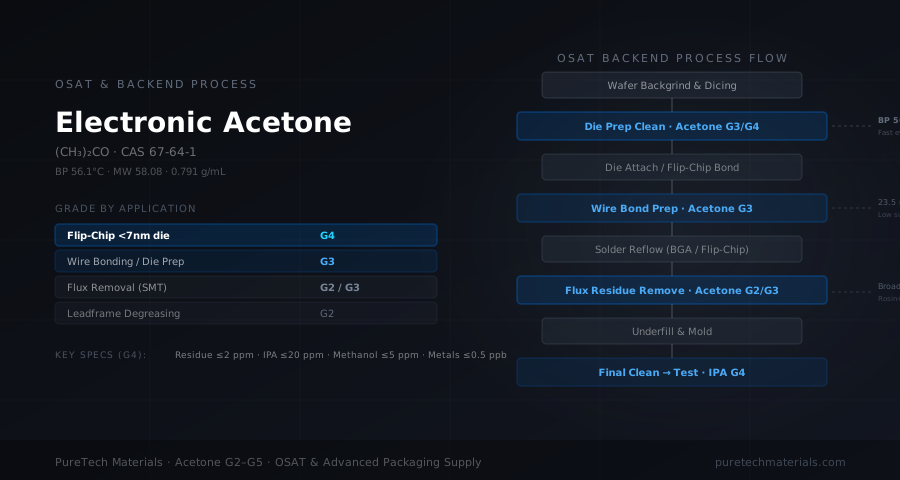
Outsourced semiconductor assembly and test (OSAT) represents the final manufacturing stage before a semiconductor device reaches end customers. OSAT facilities perform die singulation, wire bonding, flip-chip assembly, underfill dispensing, molding, and electrical testing — all of which require precise surface cleanliness. Electronic grade acetone (CAS 67-64-1) is the workhorse solvent for organic contamination removal throughout the OSAT process flow.
Why Acetone Is the Preferred OSAT Cleaning Solvent
Acetone's dominance in OSAT cleaning is explained by its combination of properties particularly suited to backend organic contamination removal:
- Low boiling point (56.1°C): Fast evaporation leaves minimal residue; critical for high-throughput packaging lines where drying time is a cycle time bottleneck.
- Broad organic solvency: Dissolves epoxy residues, rosin-based and no-clean flux residues, die attach adhesives, photoresist, and hydrocarbon contamination from handling.
- Low surface tension (23.5 mN/m): Penetrates fine pitch features — flip chip bumps at 100μm pitch, wire bond pads at 50μm pitch — to clean enclosed surfaces.
- Electrochemical inertness: Does not attack gold wire, aluminum pads, copper leadframes, or solder alloys under normal exposure conditions.
OSAT Process Applications
Die Preparation and Pre-Bond Cleaning
After wafer backgrinding and dicing, die surfaces may have contamination from dicing fluid (cutting oil emulsion), die attach film (DAF) adhesive residues, and airborne particulates from the cleanroom environment. G3 electronic grade acetone (≤5 ppb total metals) is used in immersion cleaning or spray cleaning of individual dies before wire bonding or flip-chip attach. The low metal content prevents galvanic couple formation between acetone-deposited metal ions and gold wire bond pads.
Flux Residue Removal
Solder flux — used in flip-chip solder bump reflow, BGA reflow, and SMT component attachment — leaves organic residues on the substrate surface after reflow. Even "no-clean" flux formulations leave trace organic residues that can cause adhesion failures in subsequent underfill dispensing or delamination of molding compound at elevated temperature. Acetone G3 dissolves rosin, synthetic resin, and organic acid flux activators effectively. The cleaning sequence typically uses acetone immersion followed by IPA rinse and N₂ blow-dry.
Wire Bonding Surface Preparation
The bond pad cleanliness directly determines wire pull strength and ball shear force — key reliability metrics for wire-bonded packages. Aluminum bond pads must be free of native oxide (typically removed by brief UV/ozone treatment), hydrocarbon contamination, and residual die attach adhesive. Acetone G3 cleaning followed by plasma cleaning achieves the surface energy (>70 mN/m for aluminum pads) required for reliable ball bond formation.
Lead Frame Cleaning
Copper and Alloy-42 leadframes require degreasing before die attach and wire bonding. Rolling oil residues from leadframe stamping and blanking operations contaminate the leadframe surface. G2 acetone (sufficient purity for leadframe applications) in an ultrasonic bath effectively removes rolling oil, metalworking fluid residues, and oxide scale from leadframe surfaces before silver spot plating or selective gold plating.
Grade Selection for OSAT Applications
| Application | Recommended Grade | Key Specification |
|---|---|---|
| Advanced flip-chip (sub-7nm die) | G4 | Total metals ≤0.5 ppb; particles ≤10 ct/mL |
| Wire bonding die prep | G3 | Total metals ≤2 ppb; residue ≤2 ppm |
| Flux residue removal (SMT) | G2/G3 | Total metals ≤10 ppb; residue ≤5 ppm |
| Leadframe degreasing | G2 | Assay ≥99.9%; residue ≤5 ppm |
| Equipment cleaning / maintenance | AR grade | Assay ≥99.5%; industrial grade acceptable |
Critical Specification Parameters for OSAT Acetone
Residue on Evaporation
Residue on evaporation (gravimetric method, 105°C) is the most critical specification for OSAT acetone. Any non-volatile residue remaining after acetone evaporation deposits directly on the bond pad or substrate surface, potentially causing wire bond failures or adhesion reduction. G4 spec: ≤2 ppm; G5: ≤0.5 ppm.
IPA and Methanol Content
IPA and methanol are common process impurities in acetone from industrial production. Both have higher boiling points than acetone, meaning they concentrate as acetone evaporates and can leave residues on evaporation. G4 spec: IPA ≤20 ppm, Methanol ≤5 ppm (GC-FID).
Aldehyde Content
Aldehydes (primarily propionaldehyde and acetaldehyde) form in acetone under oxidative conditions during storage. Aldehydes react with gold wire bond surfaces and aluminum pads to form organic films that reduce bondability. G4 spec: total aldehyde (as HCHO) ≤2 ppm.
Acetone Compatibility with Advanced Packaging Materials
Before deploying acetone in any packaging process, verify compatibility with exposed materials:
- Compatible: Gold wire, aluminum pads, copper leadframes, silicon die, FR4 PCB (brief exposure), polyimide tape (PI)
- Use with caution: Organic die attach adhesives (may swell), some underfill formulations, acrylic-based conformal coatings
- Incompatible: Polycarbonate lenses (crazes on contact), ABS plastic housings, some rubber seals (swells)
Conclusion
Electronic grade acetone (G2–G4) is indispensable across the OSAT process flow, from die preparation through final cleaning before molding. Grade selection is straightforward: G4 for advanced flip-chip and heterogeneous packaging (sub-10nm die), G3 for wire bonding and flux cleaning, G2 for leadframe degreasing. The most critical specifications for OSAT applications are residue on evaporation (≤2 ppm for G4), IPA content (≤20 ppm), and total metals (≤0.5 ppb for advanced packaging).
Tags
Related Search Topics
PureTech Materials — Technical Team
Practical technical content for buyers, quality teams and process specialists comparing high-purity chemical specifications, qualification evidence and supply routes. Product claims remain subject to the current controlled specification and project review.