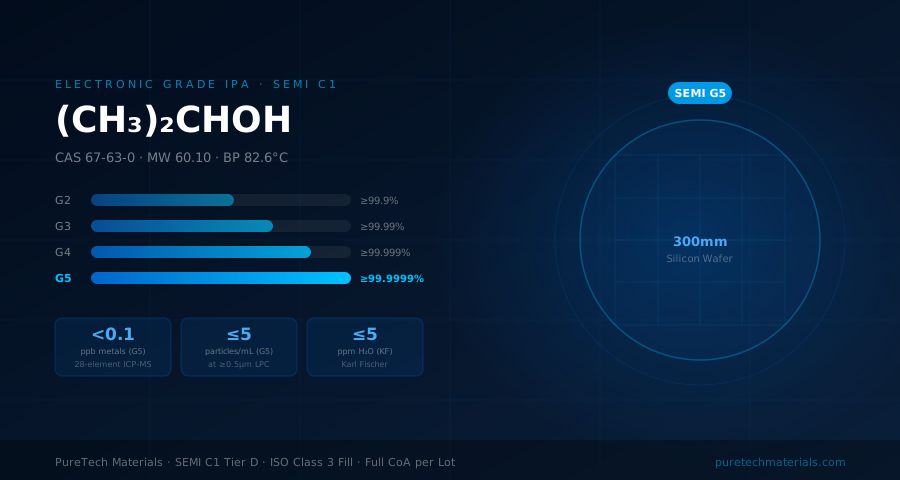
Electronic grade isopropyl alcohol (IPA, CAS 67-63-0) is the highest-volume wet process solvent in semiconductor manufacturing — consumed at every node from 28nm to sub-3nm gate-all-around (GAA) devices. Yet selecting the correct purity grade is frequently misunderstood. This guide provides a complete, process-engineer-level breakdown of SEMI G2 through G5 specifications and their fab applications.
Why IPA Purity Grade Matters at Advanced Nodes
As critical dimensions shrink below 10nm, the allowed contamination budget per process step drops proportionally. A single sodium (Na) ion at a gate oxide interface can shift threshold voltage by several millivolts. At 3nm GAA, even sub-ppb metallic contamination in rinse solvents contributes measurably to yield loss. The SEMI C1 standard defines four electronic grade tiers specifically to address this scaling challenge.
SEMI C1 Electronic Grade Tiers Explained
| Grade | Assay (GC) | Total Metals (ICP-MS) | Particles ≥0.5 μm | Water (KF) |
|---|---|---|---|---|
| G2 (Tier A) | ≥99.9% | ≤10 ppb ea. | ≤100 ct/mL | ≤50 ppm |
| G3 (Tier B) | ≥99.99% | ≤2 ppb ea. | ≤20 ct/mL | ≤20 ppm |
| G4 (Tier C) | ≥99.999% | ≤0.5 ppb ea. | ≤10 ct/mL | ≤10 ppm |
| G5 (Tier D) | ≥99.9999% | <0.1 ppb ea. | ≤5 ct/mL | ≤5 ppm |
Critical Specification Parameters
ICP-MS Metal Analysis
Inductively coupled plasma mass spectrometry (ICP-MS) is the reference method for metallic impurity quantification in electronic grade IPA. Key elements of concern include Na, K, Fe, Cu, Cr, Ni, Al, and Zn — all of which can diffuse to gate oxide or form killer defects. G5 grade requires individual element limits below 0.1 ppb, achievable only through multi-stage distillation and ion exchange purification.
Liquid Particle Counting (LPC)
In-line liquid particle counting (LPC) during ISO Class 3 fill is the industry standard for particle certification. G5 grade specifies ≤5 particles/mL at ≥0.5 μm and ≤20 particles/mL at ≥0.2 μm. Particles in rinse IPA are a leading cause of post-CMP yield excursions and mask defects in lithography.
Water Content (Karl Fischer)
Residual water in IPA affects Marangoni drying efficiency. The Marangoni effect relies on a surface tension gradient between IPA vapor and deionized water; excess water in the IPA reduces this gradient, causing watermarks and particle redeposition. G5 grade (≤5 ppm water) is specified for all Marangoni drying applications.
Process-Specific Grade Selection
Post-CMP Brush Scrub & SRD
Chemical mechanical planarization (CMP) post-clean typically requires G4 grade IPA for brush scrub and spin-rinse-dry (SRD). The cleaning sequence removes residual slurry particles, copper ions (for Cu interconnect CMP), and organic residues. G4 provides sufficient purity for 14–28nm nodes; G5 is specified for leading-edge 3–7nm Cu CMP post-clean.
Marangoni Drying
Marangoni drying replaces conventional spin-dry to eliminate watermarks and achieve stiction-free drying for MEMS structures and high-aspect-ratio features. G5 grade IPA with ≤5 ppm water is the industry standard. IPA vapor is introduced above the water surface as the wafer is slowly withdrawn, creating a surface tension gradient that sweeps water from the wafer surface without spin-induced defects.
EUV Lithography Tool Maintenance
EUV scanners require periodic pellicle and reticle pod cleaning with ultra-high-purity IPA. The extreme sensitivity of EUV optics to hydrocarbon contamination means G5 grade with ≤1 ppb total carbon is specified for all tool-internal cleaning procedures.
Photomask & Reticle Cleaning
Photomask cleaning uses a cascade of wet chemicals followed by G4 or G5 IPA rinse. Any metallic contamination or particles remaining on the mask print directly to every wafer exposed with that reticle, making purity requirements among the most stringent in the fab.
Packaging and Supply Chain Considerations
Electronic grade IPA is supplied in fluoropolymer-lined or ultra-clean stainless containers, from 4L for tool qualification to 200L drums and 1000L IBCs for production supply. N₂ blanket packaging prevents moisture absorption during storage and transportation. Lot-specific CoA with ICP-MS and LPC data should accompany every shipment. High-volume fabs typically require bulk tanker delivery with continuous N₂ blanketing.
Conclusion
Selecting the correct electronic grade IPA tier directly impacts fab yield. G4 grade provides the right balance of purity and cost-effectiveness for most 14nm+ applications; G5 (6N purity) is essential for sub-7nm nodes, EUV processes, and Marangoni drying. Always specify ICP-MS and LPC certification with each lot, and verify that your supplier's fill environment meets ISO Class 3 requirements.
Tags
Related Search Topics
PureTech Materials — Technical Team
Practical technical content for buyers, quality teams and process specialists comparing high-purity chemical specifications, qualification evidence and supply routes. Product claims remain subject to the current controlled specification and project review.


