Dimethyl carbonate (DMC, CAS 616-38-6, molecular formula (CH₃O)₂CO) is an organic carbonate ester widely used as a co-solvent in lithium-ion battery electrolytes. Together with ethylene carbonate (EC) and ethyl methyl carbonate (EMC), DMC forms the standard ternary solvent system for commercial LiPF₆-based electrolytes used in virtually all EV and consumer battery applications.
Physicochemical Properties Relevant to Battery Applications
| Property | Value | Relevance |
|---|---|---|
| Boiling point | 90 °C | Low BP enables easy drying; flash point safety consideration |
| Viscosity (25°C) | 0.59 mPa·s | Lowest viscosity of common carbonate solvents — improves Li⁺ conductivity |
| Dielectric constant | 3.1 | Low ε; must be blended with high-ε solvents (EC) for Li⁺ dissociation |
| Melting point | 4.6 °C | Liquid at room temperature; extends low-temperature operation |
| Electrochemical window | >5.0 V vs. Li/Li⁺ | Stable with high-voltage NMC cathodes (≤4.35 V) |
| Density (25°C) | 1.069 g/mL | Relevant for electrolyte formulation by weight/volume |
Standard EC/DMC/EMC Electrolyte Formulation
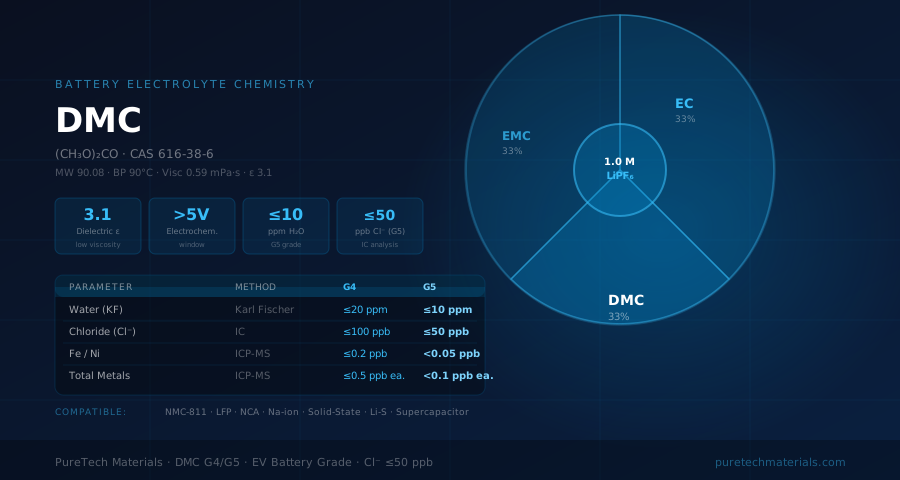
The most widely used commercial lithium-ion electrolyte is 1.0 M LiPF₆ in EC/DMC/EMC (1:1:1 by volume). Each solvent serves a specific function:
- EC (ethylene carbonate): High dielectric constant (ε = 89.8) enables Li⁺ dissociation from PF₆⁻. Also forms a stable SEI layer on graphite anodes via reductive decomposition at ~0.8 V vs. Li/Li⁺.
- DMC: Low viscosity reduces solution resistance and improves ion mobility. High electrochemical oxidation stability enables NMC cathode compatibility. Co-solvent that reduces the high melting point and viscosity of pure EC (melts at 36°C).
- EMC (ethyl methyl carbonate): Intermediate properties between EC and DMC. Improves low-temperature performance by reducing electrolyte freezing point.
DMC Grade Requirements for Battery Applications
Water Content Control
Water is the most critical impurity in DMC for battery applications. LiPF₆ reacts with water to form HF and LiF:
LiPF₆ + H₂O → LiF + POF₃ + 2HF
HF attacks the cathode surface, dissolves transition metals (Mn, Ni, Co), and degrades the SEI layer on the anode. G5 grade DMC (≤10 ppm H₂O) is specified for premium cell electrolyte formulations. Even G4 (≤20 ppm H₂O) requires careful handling in dry rooms (dew point ≤ -40°C) to prevent moisture uptake before electrolyte mixing.
Chloride and Fluoride Control
Chloride (Cl⁻) and fluoride (F⁻) anions in DMC originate from synthesis by-products (phosgene or CO₂/methanol routes use HCl as a by-product). These anions catalyze LiPF₆ decomposition and corrode stainless steel electrolyte handling equipment. G5 spec: Cl⁻ ≤50 ppb, F⁻ ≤20 ppb by ion chromatography (IC).
Metal Contamination
Iron and nickel from synthesis reactors or transport containers catalyze electrolyte decomposition reactions and deposit as metallic particles in cells. G4 spec: Fe ≤0.2 ppb, Ni ≤0.2 ppb by ICP-MS. G5 (premium): Fe, Ni <0.05 ppb.
DMC in Next-Generation Battery Chemistries
Solid-State Batteries (SSB)
Quasi-solid and gel polymer electrolytes for SSB often use DMC as a processing solvent for polymer matrix casting. Ultra-pure G5 DMC (total metals <0.1 ppb) prevents transition metal contamination of ceramic or polymer solid electrolyte membranes.
Sodium-Ion Batteries (SIB)
Sodium-ion batteries use analogous electrolyte formulations to Li-ion — typically 1.0 M NaPF₆ or NaClO₄ in EC/DMC mixtures. The same purity requirements apply, as Na⁺ ion transport is equally sensitive to HF-generating impurities.
Lithium-Sulfur (Li-S) Batteries
Li-S electrolytes based on ether solvents (DOL/DME) sometimes incorporate small amounts of DMC to improve polysulfide dissolution kinetics. Low water content is critical to prevent lithium metal anode passivation.
Green Chemistry Perspective
DMC is classified as a "green solvent" — it is biodegradable, has low acute toxicity (LD₅₀ rat oral >13,000 mg/kg), and can be synthesized by CO₂ carbonylation of methanol without generating halogenated by-products. This positions DMC favorably in LCA analyses compared to traditional carbonate synthesis routes using phosgene.
Conclusion
Electronic grade DMC is a critical material in the lithium-ion battery supply chain. G4 grade (≤20 ppm H₂O, ≤0.5 ppb total metals, ≤100 ppb Cl⁻) serves most EV battery production applications. G5 grade with sub-0.1 ppb metal control and ≤10 ppm water is specified for high-cycle-life premium cells and solid-state battery research.
Tags
Related Search Topics
PureTech Materials — Technical Team
Practical technical content for buyers, quality teams and process specialists comparing high-purity chemical specifications, qualification evidence and supply routes. Product claims remain subject to the current controlled specification and project review.