N-methyl-2-pyrrolidone (NMP, CAS 872-50-4) is the dominant process solvent in lithium-ion battery electrode manufacturing, consumed in volumes of hundreds of kilograms per GWh of cell production capacity. Despite growing regulatory pressure to develop aqueous alternatives, NMP remains the only industrially proven solvent for high-performance PVDF (polyvinylidene fluoride) binder dissolution in NMC, NCA, and LFP cathode systems.
Why NMP is Essential for PVDF Binder Dissolution
PVDF is the standard cathode binder for lithium-ion batteries because of its electrochemical stability, mechanical flexibility, and adhesion to aluminum current collectors. However, PVDF is a semi-crystalline fluoropolymer that requires a highly polar aprotic solvent for dissolution. NMP's Hansen solubility parameters (δD = 18.0, δP = 12.3, δH = 7.2 MPa½) closely match those of PVDF, making it uniquely effective at dissolving PVDF at concentrations of 6–12% (w/w) at 60–80°C.
Alternative polar aprotic solvents (DMF, DMAc, DMSO) are technically capable of dissolving PVDF but introduce additional impurity risks, regulatory complications, or binder compatibility issues that have prevented commercial adoption at scale.
Cathode Slurry Preparation Process
A typical NMC-811 cathode slurry preparation sequence illustrates NMP's role:
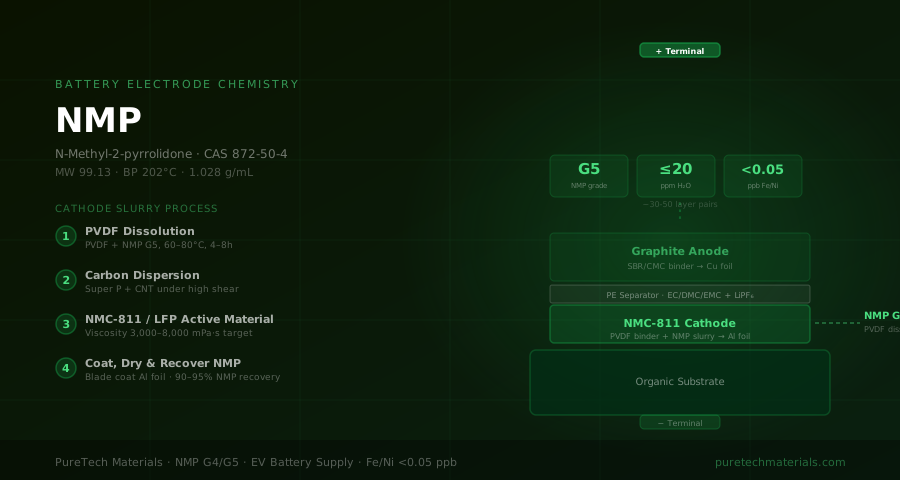
- PVDF dissolution: PVDF powder is dissolved in anhydrous NMP (≤50 ppm H₂O) at 60–80°C with high-shear mixing for 4–8 hours to form a homogeneous binder solution.
- Carbon black dispersion: Conductive carbon (Super P, carbon nanotubes) is added to the PVDF/NMP solution and dispersed under high shear to break agglomerates below 1 μm.
- Active material addition: NMC-811 or LFP powder is gradually incorporated with controlled mixing to avoid particle damage.
- Viscosity adjustment: Additional NMP is added to achieve target slurry viscosity (typically 3,000–8,000 mPa·s at 25°C) for blade coating on the current collector.
- Coating and drying: The slurry is coated onto aluminum foil at 0.5–2.0 m/min, then dried in a series of heated zones at 80–120°C to evaporate NMP. Recovered NMP is purified and recycled.
Electronic Grade NMP Purity Requirements
Battery-grade NMP must meet stringent purity requirements because metallic contamination directly compromises cell electrochemistry:
| Parameter | Method | G4 Spec | G5 Spec |
|---|---|---|---|
| Assay (GC) | GC-FID | ≥99.99% | ≥99.999% |
| Water (KF) | Karl Fischer | ≤50 ppm | ≤20 ppm |
| Fe (Iron) | ICP-MS | ≤0.2 ppb | <0.05 ppb |
| Ni (Nickel) | ICP-MS | ≤0.2 ppb | <0.05 ppb |
| Total Metals | ICP-MS | ≤0.5 ppb ea. | <0.1 ppb ea. |
| Color (APHA) | ASTM D1209 | ≤10 Hazen | ≤5 Hazen |
| Residue on Evap. | Gravimetric | ≤5 ppm | ≤2 ppm |
Why Iron and Nickel Control Is Critical
Iron contamination in cathode slurry is a leading cause of lithium dendrite formation and internal short circuit events. A single iron particle dissolved in the slurry can deposit as metallic iron on the anode during charging, nucleating a dendrite that penetrates the separator over hundreds of charge cycles. G5 grade NMP with <0.05 ppb Fe is specified for premium EV cell applications where cycle life exceeds 1,000 full cycles.
Water Content and Its Impact on Slurry Quality
Residual water in NMP causes multiple problems in cathode slurry processing. Water reacts with LiPF₆ electrolyte (if present from contaminated active material) to generate HF, which attacks the aluminum current collector. More commonly, excess moisture causes PVDF precipitation during dissolution, forming gel particles that create coating defects. Anhydrous-grade NMP (≤30 ppm H₂O) is specified for facilities without dedicated NMP moisture control systems.
NMP Recovery and Recycling
NMP is expensive ($2–5/kg at industrial grade; $8–15/kg at G4 electronic grade) and its vapor is subject to occupational exposure limits (OEL: 10 ppm TWA in EU; reproductive toxicant classification). Large-scale battery manufacturers invest in NMP recovery systems that condense evaporated NMP from drying ovens, purify it by distillation, and recycle it at 90–95% recovery rate. Recovered NMP is re-tested against G4 specification before reuse.
NMP for Anode Slurry and Semiconductor Applications
Beyond cathode slurry, electronic grade NMP is used for silicon-graphite composite anode binder dissolution (polyimide or SBR/CMC systems), polyimide precursor coating in semiconductor advanced packaging (HDI, flex PCB, RDL layers), and thick photoresist stripping in semiconductor fab. These applications share the same G4/G5 purity requirements for metal content and water.
Conclusion
NMP's unique solvency for PVDF binder makes it irreplaceable in lithium-ion battery electrode manufacturing at current technology readiness levels. Electronic grade G4 NMP — with ≤0.5 ppb total metals, ≤50 ppm water, and APHA color ≤10 — is the baseline specification for EV-grade cell production. For high-cycle-life premium cells, G5 grade with <0.05 ppb Fe/Ni is increasingly specified by leading cell manufacturers.
Tags
Related Search Topics
PureTech Materials — Technical Team
Practical technical content for buyers, quality teams and process specialists comparing high-purity chemical specifications, qualification evidence and supply routes. Product claims remain subject to the current controlled specification and project review.