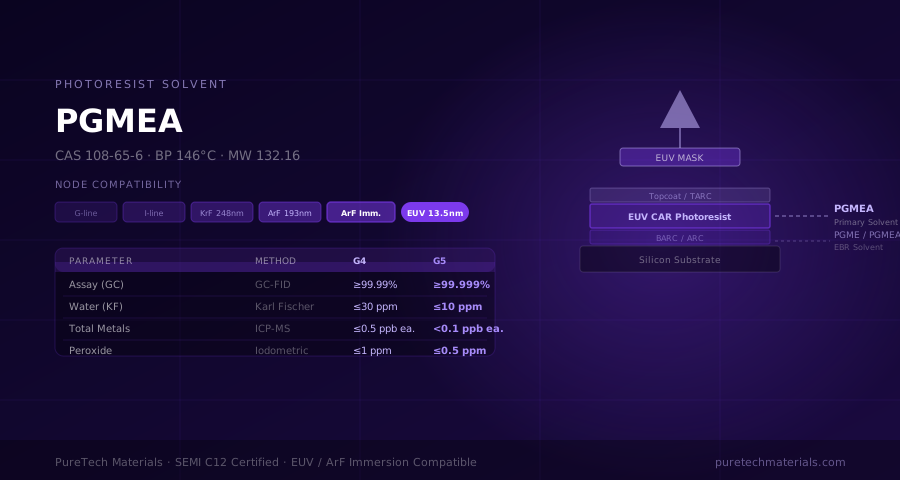
PGMEA is widely used as a solvent for advanced semiconductor resist technology, but assay alone does not predict coating performance. The solvent enters a formulation whose viscosity, evaporation profile and wetting behaviour determine film uniformity and edge condition. Water, acidity, organic impurities, non-volatile residue and particles can therefore become sources of variation even when the headline purity looks strong.
High purity protects the formulation window
SEMI C72 covers PGMEA, PGME and a 70/30 PGME/PGMEA mixture used in advanced resist technology. For a real purchasing specification, translate that process context into measurable limits. Request the organic impurity profile, water, acidity, residue, trace-metal panel and particle data, together with the test methods and reporting limits. Compare the high-purity PGMEA product route with the actual resist chemistry and coating track.
Lower contamination and tighter lot-to-lot results help remove the solvent as an uncontrolled variable. They do not guarantee a nanometre film-thickness target by themselves; dispense volume, spin speed, temperature, humidity and resist age still matter. The useful supplier advantage is a material whose measured attributes remain inside the qualified window from sample to production scale.
Qualify coating stability across representative lots
Run multiple PGMEA lots through the same formulation and track conditions. Compare mean film thickness and within-wafer range, edge-bead width, defect maps, drying behaviour and post-bake appearance. Keep the container and closure consistent with the intended production pack, because storage and transfer can affect moisture and particles.
Use analytical testing to align methods and limits, connect each result to batch traceability, and document changes that would require requalification. For a sample plan tied to your resist or coating system, request a PGMEA technical review.
Primary sources
Tags
Related Search Topics
PureTech Materials — Technical Team
Practical technical content for buyers, quality teams and process specialists comparing high-purity chemical specifications, qualification evidence and supply routes. Product claims remain subject to the current controlled specification and project review.