Propylene glycol monomethyl ether acetate (PGMEA, CAS 108-65-6) has been the dominant primary solvent in positive chemically amplified photoresists (CAR) since the transition to 248nm KrF lithography in the 1990s. Today it remains essential at EUV (13.5nm) and beyond, serving as the primary solvent in both polymer-based CAR formulations and emerging metal oxide resist (MOR) systems.
Why PGMEA Became the Standard Photoresist Solvent
PGMEA's dominance is explained by its unique combination of physicochemical properties:
- High solvency for resist polymers: PGMEA dissolves poly(hydroxystyrene) (PHS), poly(methacrylic acid) (PMAA), and acrylate-based EUV resist polymers at the high concentrations (15–40% w/w) required for precise film thickness control.
- Moderate boiling point (146°C): Enables controlled evaporation during spin coating, producing uniform films from 20nm to 10μm thickness.
- Low surface tension: Allows complete wetting of hydrophobic resist-on-wafer surfaces without voids or edge defects.
- Compatibility with TMAH developer: PGMEA residues are fully removed by 2.38% TMAH aqueous developer used in positive tone development (PTD) processes.
PGMEA in EUV Chemically Amplified Resists
EUV lithography at 13.5nm wavelength requires resists with high photon absorption, low line edge roughness (LER), and exceptional sensitivity. Current EUV CAR formulations use PGMEA as the primary solvent at concentrations of 85–92% (w/w) in the final formulated resist. The solvent must meet exceptionally tight specifications because any metallic impurity in the resist can cause EUV-induced contamination of scanner optics — a multi-million-dollar remediation event.
Metal Contamination Control
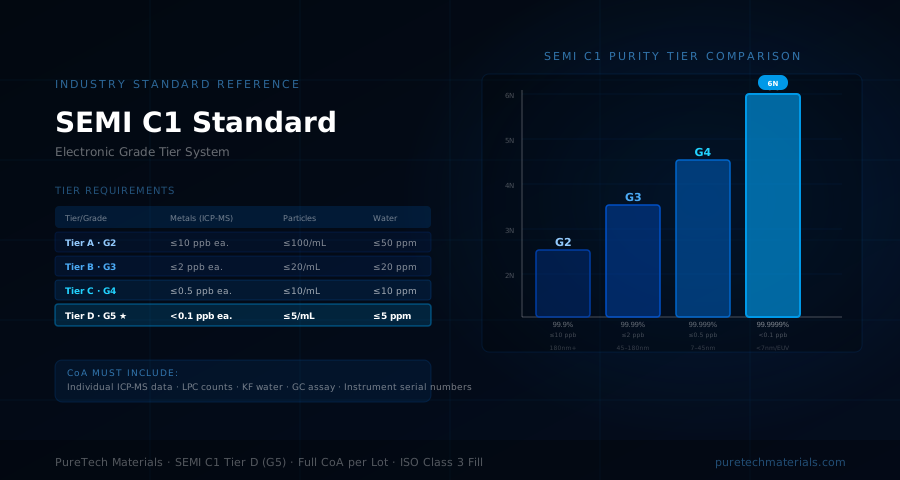
EUV resist grade PGMEA (G5) requires total metals below 0.1 ppb per element by ICP-MS. Iron and chromium are of particular concern because they absorb EUV photons and can deposit on mirror surfaces. Tin (Sn) from the EUV source plasma is also monitored in the fab environment.
PGMEA in Metal Oxide Resists (MOR)
Next-generation EUV resists based on tin-oxo clusters and hafnium oxide nanoparticles use PGMEA as the primary dissolution solvent. These inorganic MOR systems offer higher EUV absorption cross-sections, enabling reduced exposure doses and improved shot noise characteristics. PGMEA dissolves the metal oxide resist precursors while meeting the stringent anion (Cl⁻, F⁻) requirements — typically <0.1 ppb — to prevent corrosion of resist spin coating tools.
Edge Bead Removal (EBR)
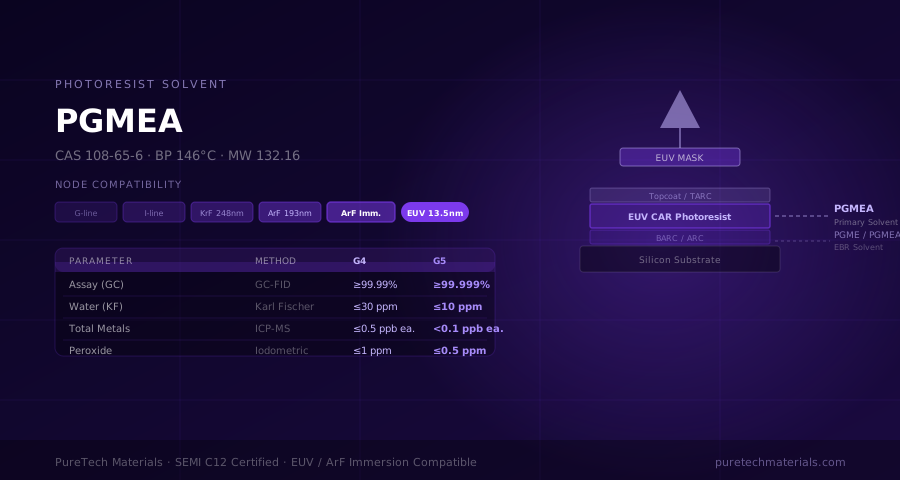
During photoresist spin coating, a thick bead of resist accumulates at the wafer edge. This edge bead causes adhesion defects in wafer handling and cross-contamination in cassettes. PGMEA (or PGME) is dispensed to the wafer edge by a dedicated nozzle during the spin coating process to dissolve and remove this bead before soft bake. EBR-grade PGMEA uses G4 specification because it contacts only the resist, not the active device area.
Spin-On Carbon (SOC) and Hard Mask Applications
PGMEA is also the primary solvent for spin-on carbon (SOC) hard mask materials used in multi-patterning schemes (LELE, SAQP). SOC provides the etch selectivity required to transfer EUV or ArF patterns through multiple material layers. PGMEA dissolves the graphitic polymer at appropriate concentrations for 50–200nm film applications.
Critical PGMEA Specification Parameters
| Parameter | Method | G4 Spec | G5 Spec |
|---|---|---|---|
| Assay (GC) | GC-FID | ≥99.99% | ≥99.999% |
| Water (KF) | Karl Fischer | ≤30 ppm | ≤10 ppm |
| Total Metals | ICP-MS | ≤0.5 ppb ea. | <0.1 ppb ea. |
| Acetic Acid | GC-FID | ≤20 ppm | ≤5 ppm |
| PGME (residual) | GC-FID | ≤50 ppm | ≤20 ppm |
| Peroxide (as H₂O₂) | Iodometric | ≤1 ppm | ≤0.5 ppm |
PGME vs. PGMEA: When to Use Each
PGME (propylene glycol monomethyl ether, CAS 107-98-2) is PGMEA without the acetate group. It has a lower boiling point (120°C vs. 146°C) and is preferred for edge bead removal and as a co-solvent to reduce resist viscosity. PGMEA is preferred as the primary resist solvent where a higher boiling point improves film uniformity during spin coating. Many resist formulations blend both solvents to achieve the target evaporation profile.
Conclusion
PGMEA's unique combination of polymer solvency, boiling point, and compatibility with photolithography chemistries has sustained its position as the primary photoresist solvent from 248nm through EUV. As EUV and high-NA EUV become high-volume manufacturing nodes, G5 grade PGMEA with sub-0.1 ppb metal control becomes the baseline specification for resist formulation solvents.
Tags
Related Search Topics
PureTech Materials — Technical Team
Practical technical content for buyers, quality teams and process specialists comparing high-purity chemical specifications, qualification evidence and supply routes. Product claims remain subject to the current controlled specification and project review.