SEMI International Standards provides the semiconductor industry's foundational framework for electronic chemical specification. SEMI C1 — "Specification for Reagents Used in the Electronics Industry" — defines four graduated purity tiers for bulk electronic grade chemicals, used by fabs, chemical suppliers, and procurement engineers worldwide as the basis for qualification and supply agreements.
What SEMI C1 Covers
SEMI C1 applies to liquid and gaseous chemicals used in semiconductor device manufacturing processes, including:
- Cleaning and rinsing solvents (IPA, ethanol, acetone)
- Photoresist process solvents (PGMEA, PGME, butyl acetate)
- Process acids and bases (HF, HCl, H₂SO₄, NH₄OH, H₂O₂)
- Ultra-pure water (UPW)
The standard defines test methods, reporting requirements, and supplier quality documentation requirements. SEMI C12 is the companion standard specifically for photoresist process chemicals (PGMEA, PGME, butyl acetate, propyl acetate).
The Four SEMI C1 Tiers
Tier A (Grade G2) — General Electronic Grade
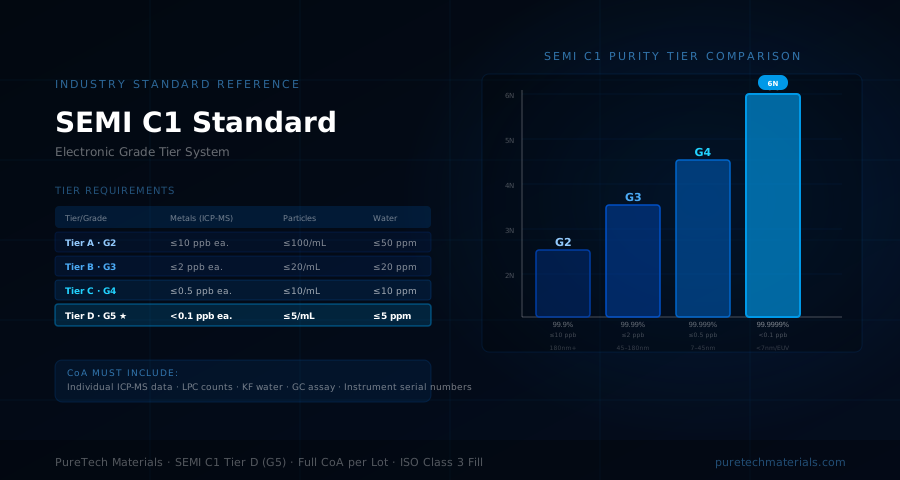
Tier A represents the entry-level electronic grade, suitable for 150–200mm wafer processes and mature technology nodes (≥180nm). Key limits: total metals ≤10 ppb per element (ICP-MS), particles ≤100 ct/mL at ≥0.5 μm (LPC), water ≤50 ppm (KF). Tier A materials are produced in conventional distillation equipment with standard cleanroom fill.
Tier B (Grade G3) — Intermediate Electronic Grade
Tier B is specified for 200–300mm fabs at 45–180nm nodes. Metals ≤2 ppb, particles ≤20 ct/mL at ≥0.5 μm (and ≤100 ct/mL at ≥0.2 μm), water ≤20 ppm. Tier B requires ion exchange purification in addition to distillation and ISO Class 5 or better fill environments.
Tier C (Grade G4) — Advanced Electronic Grade
Tier C covers 300mm wafer fabs at 14–45nm nodes. Metals ≤0.5 ppb per element (28-element ICP-MS scan required), particles ≤10 ct/mL at ≥0.5 μm and ≤50 ct/mL at ≥0.2 μm, water ≤10 ppm. Tier C requires multi-stage distillation with ion exchange, certified ultra-clean containers, and ISO Class 3–4 fill with in-line LPC certification per container.
Tier D (Grade G5) — Ultra-High Purity
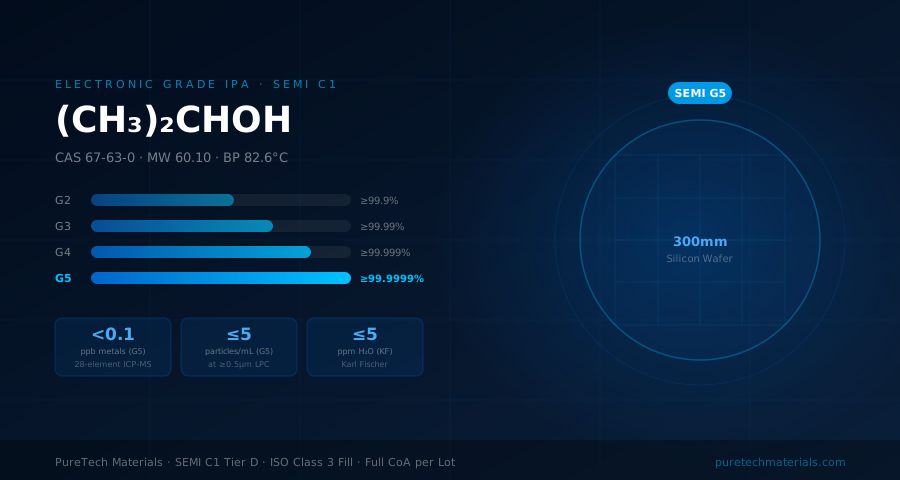
Tier D is the highest SEMI C1 tier, required for sub-7nm logic, EUV lithography processes, and Marangoni drying. Total metals <0.1 ppb per element (28 elements including low-level Sn, Sb, Bi), particles ≤5 ct/mL at ≥0.5 μm and ≤20 ct/mL at ≥0.2 μm, water ≤5 ppm. Tier D requires dedicated production campaigns with validated ultra-clean fill lines and per-container LPC certification. Every Tier D container must be accompanied by a full CoA with individual element ICP-MS data.
SEMI C1 Required Test Methods
ICP-MS (Inductively Coupled Plasma Mass Spectrometry)
ICP-MS is the required method for metal impurity quantification at Tier B through D levels. A minimum of 28 elements is specified: Na, Mg, Al, K, Ca, Ti, V, Cr, Mn, Fe, Co, Ni, Cu, Zn, As, Sr, Mo, Ag, Cd, Sn, Sb, Ba, W, Au, Pb, Bi, and user-defined elements (commonly Ge, In for specific process applications). Detection limits must be verified by method blanks and certified reference materials with each analytical run.
Liquid Particle Counting (LPC)
LPC is performed using a laser particle counter (typically HIAC ROYCO or equivalent) calibrated with NIST-traceable polystyrene latex (PSL) size standards. In-line LPC during fill (rather than offline sampling) is required for Tier C and D certification because sampling introduces particles from the sampling vessel. The SEMI C1 fill certification protocol specifies the number of volume samples and statistical confidence interval required for particle count certification.
Karl Fischer Titration (KF)
Water content is measured by volumetric or coulometric KF titration. For Tier D (≤5 ppm H₂O), coulometric KF with a detection limit of 1 ppm or better is required. Sampling protocol specifies N₂ purging of the titration vessel and use of anhydrous reagents to prevent ambient moisture contamination of the sample.
Reading a SEMI C1 Certificate of Analysis
A compliant CoA must include:
- Lot number and batch size
- Claimed SEMI tier (G2/G3/G4/G5)
- Assay result (GC-FID method)
- Individual element ICP-MS data (all 28 elements, actual measured values — not "pass/fail")
- LPC data (actual count ± uncertainty, not just "compliant")
- KF water result
- Instrument serial numbers and calibration dates
- Analyst signature and QA release authorization
SEMI C12 for Photoresist Process Chemicals
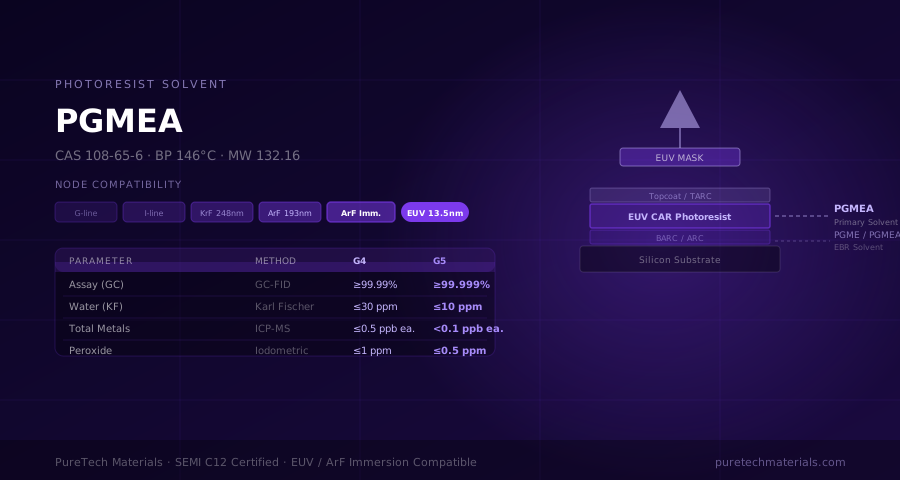
SEMI C12 applies specifically to PGMEA, PGME, n-propyl acetate, and n-butyl acetate — the primary photoresist process solvents. C12 adds photoresist compatibility testing (contact angle, film uniformity on silicon) to the base C1 requirements, and specifies acidity (as acetic acid), peroxide content, and color (APHA/Hazen) as additional parameters reflecting the sensitivity of photoresist performance to these impurities.
Conclusion
SEMI C1 provides a standardized framework for electronic grade chemical specification that enables fabs, OSATs, and chemical suppliers to communicate purity requirements unambiguously. When procuring electronic grade chemicals, always specify the SEMI C1 tier explicitly in the purchase order, require a full CoA with individual element ICP-MS data and in-line LPC per container, and periodically re-qualify your supplier's fill environment against SEMI C1 audit requirements.
Tags
Related Search Topics
PureTech Materials — Technical Team
Practical technical content for buyers, quality teams and process specialists comparing high-purity chemical specifications, qualification evidence and supply routes. Product claims remain subject to the current controlled specification and project review.