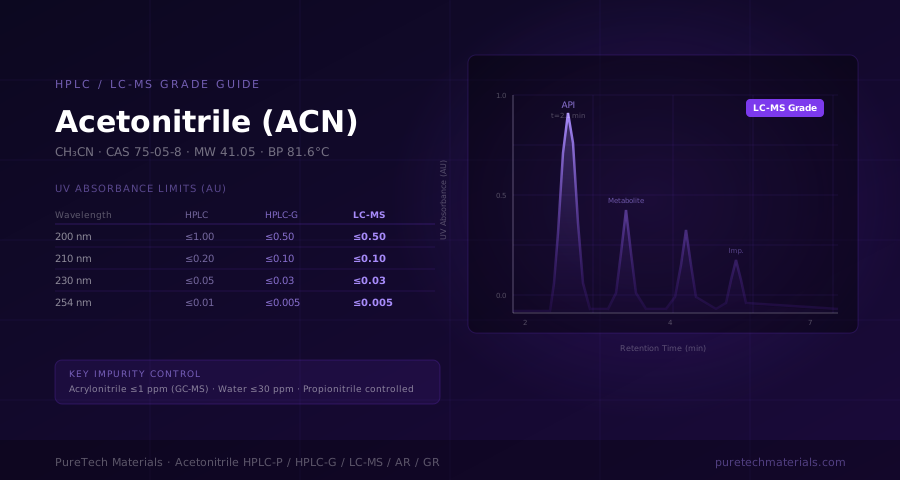
Acetonitrile (MeCN, ACN, CAS 75-05-8) is the gold standard mobile phase solvent for reverse-phase HPLC and LC-MS/MS in pharmaceutical analysis, bioanalytical testing, and environmental monitoring. Its low UV cutoff, low viscosity, and excellent miscibility with water make it the preferred choice for RP-HPLC — yet the differences between acetonitrile grades are frequently misunderstood, leading to either wasted budget on over-specified solvent or analytical failures from under-specified mobile phases.
Acetonitrile Grade Classification
Commercial acetonitrile for analytical use is sold in four primary grades, each defined by increasingly strict UV absorbance and chemical purity specifications:
| Grade | Assay | UV 200nm | UV 210nm | UV 254nm | Water |
|---|---|---|---|---|---|
| HPLC Prep | ≥99.9% | ≤1.00 AU | ≤0.20 AU | ≤0.01 AU | ≤50 ppm |
| HPLC Gradient | ≥99.9% | ≤0.50 AU | ≤0.10 AU | ≤0.005 AU | ≤30 ppm |
| HPLC | ≥99.9% | ≤1.00 AU | ≤0.20 AU | ≤0.01 AU | ≤50 ppm |
| LC-MS | ≥99.9% | ≤0.50 AU | ≤0.10 AU | ≤0.005 AU | ≤30 ppm |
Understanding UV Absorbance Cutoffs
The UV absorbance of acetonitrile at specific wavelengths defines which detection methods it is compatible with. UV absorption by the solvent creates a baseline offset that limits analyte detection sensitivity.
UV Detector Applications (210–280nm)
Standard UV detection of pharmaceuticals typically occurs at 210–280nm, where most aromatic and carbonyl-containing drug molecules absorb. HPLC gradient grade (UV 210nm ≤0.10 AU) provides adequate baseline flatness for isocratic methods. For gradient elution methods where baseline rise from increasing organic modifier can confound peak integration, HPLC gradient grade with ≤0.05 AU at 210nm is essential.
LC-MS Applications
LC-MS grade acetonitrile is optimized for electrospray ionization (ESI) and atmospheric pressure chemical ionization (APCI) interfaces. While mass detectors do not measure UV absorbance, the same chemical impurities that elevate UV absorbance (propionitrile, allyl cyanide, acrylonitrile) also suppress ionization efficiency and create chemical background in the mass spectrum. LC-MS grade provides the cleanest background for MRM (multiple reaction monitoring) quantitation at trace levels (pg/mL) in plasma matrices.
Critical Impurities in Acetonitrile
Acrylonitrile
Acrylonitrile (CH₂=CHCN) is the primary synthesis-related impurity in acetonitrile, formed by dehydration during production. It is a UV absorber at 210nm and an ESI ionization suppressant. LC-MS grade specifies acrylonitrile ≤1 ppm. At higher concentrations, it creates ghost peaks in LC-MS/MS methods and elevates chemical noise in the 53 Da (acrylonitrile M+H) channel.
Propionitrile
Propionitrile (CH₃CH₂CN) is a UV absorber that co-elutes with early-eluting analytes in RP-HPLC. In gradient methods ramping from 5% to 95% acetonitrile, propionitrile concentrates at the head of the gradient and elutes as a broad UV-absorbing front at low retention times.
Water
Residual water in acetonitrile affects retention time reproducibility in RP-HPLC because water changes the effective mobile phase polarity. LC-MS grade (≤30 ppm H₂O) ensures day-to-day retention time reproducibility within 0.01 minute for validated pharmaceutical methods.
Acetonitrile Shortage and Supply Security
The 2008–2009 acetonitrile shortage — caused by the global financial crisis reducing automobile production (acetonitrile is a by-product of acrylonitrile synthesis, used in ABS plastics) — highlighted the vulnerability of the pharmaceutical analytical supply chain. Laboratories that maintained 6-month safety stock were unaffected. Acetonitrile supply security is now a key consideration for pharmaceutical QC operations, typically requiring dual-qualified suppliers and blanket purchase agreements.
Selecting the Right Grade: Decision Guide
- Preparative HPLC / fraction collection: HPLC Prep grade. UV absorbance less critical; volume and cost drive selection.
- Isocratic UV detection (210–280nm): HPLC grade is sufficient for most applications.
- Gradient UV detection or tight system suitability: HPLC Gradient grade provides lower baseline slope during gradient runs.
- LC-MS/MS quantitation (plasma, urine, tissue): LC-MS grade essential. The background chemical noise from lower grades compromises sensitivity at pg/mL concentrations.
- UHPLC with sub-2-μm columns: LC-MS grade recommended to prevent pressure build-up from particulate impurities.
Conclusion
Matching acetonitrile grade to your analytical application avoids both performance failures and unnecessary cost. LC-MS grade is the correct specification for any method involving mass detection, ESI, or APCI. HPLC gradient grade serves most UV-based gradient methods. For truly critical applications — low-level impurity profiling by LC-MS/MS or method validation — always qualify the specific lot of acetonitrile as part of system suitability.
Tags
Related Search Topics
PureTech Materials — Technical Team
Practical technical content for buyers, quality teams and process specialists comparing high-purity chemical specifications, qualification evidence and supply routes. Product claims remain subject to the current controlled specification and project review.
