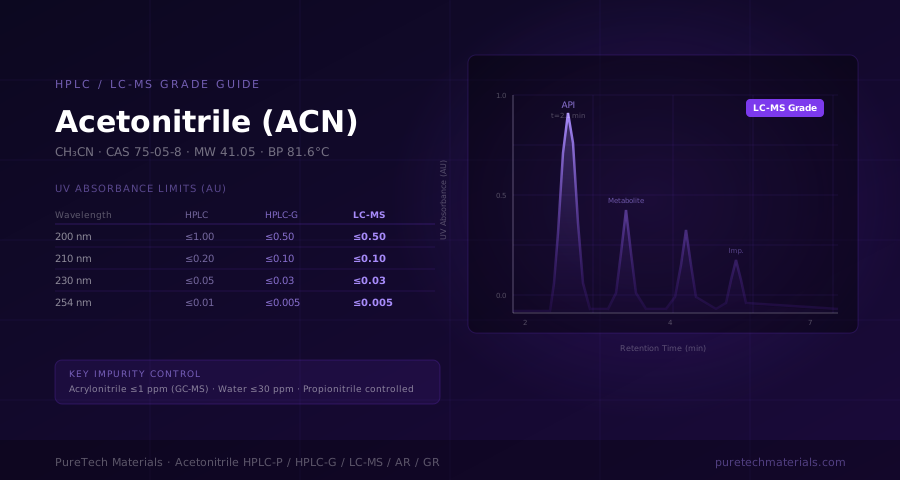
Low-wavelength HPLC exposes solvent quality quickly. Thermo Fisher's UV-detection guidance lists 190 nm as the minimum wavelength for acetonitrile, so a method operating near that region has little margin for UV-absorbing impurities. A small change between solvent lots can appear as baseline movement, noise or an unexpected peak—especially during a gradient.
Purity must be interpreted at the working wavelength
A general assay does not show how a solvent behaves in the detector. Review absorbance or transmittance at the method wavelength, the UV cutoff convention, water, residue and relevant organic impurities. Agilent also highlights low impurity levels for reducing ghost peaks, lot-to-lot reproducibility and 0.2 μm prefiltration in its HPLC acetonitrile range. Those are useful qualification categories even when a laboratory sets different acceptance limits.
Start with the acetonitrile grade portfolio, then match the specification to the detector, column and gradient. For LC-MS work, include ion background and adduct behaviour; for UV methods, focus on the actual wavelength range and programmed solvent composition.
Verify stability with a blank gradient
Run a blank using the final mobile-phase preparation, bottles, tubing and gradient. Compare baseline slope, noise and ghost peaks across representative lots under identical conditions. Record detector wavelength, reference wavelength, temperature, preparation date and bottle position so the comparison can be repeated. A spectral scan can help distinguish broad solvent absorbance from a discrete contaminant peak.
High purity and low UV absorbance are valuable because they reduce the solvent's contribution to analytical variation; they do not replace system suitability. Align the supplier CoA with laboratory testing controls and controlled documentation. To review a current wavelength and gradient, request an acetonitrile qualification discussion.
Primary sources
Tags
Related Search Topics
PureTech Materials — Technical Team
Practical technical content for buyers, quality teams and process specialists comparing high-purity chemical specifications, qualification evidence and supply routes. Product claims remain subject to the current controlled specification and project review.