Wafer drying is one of the most defect-critical steps in semiconductor wet processing. Conventional spin-drying (where water is removed by centrifugal force) leaves residual watermarks — rings of dissolved minerals deposited as water evaporates. At sub-7nm nodes, even sub-nm watermark residues cause pattern collapse, adhesion failures in subsequently deposited films, and local threshold voltage variation. Marangoni drying, using isopropyl alcohol vapor, has become the industry solution for watermark-free drying at advanced nodes.
The Physics of the Marangoni Effect
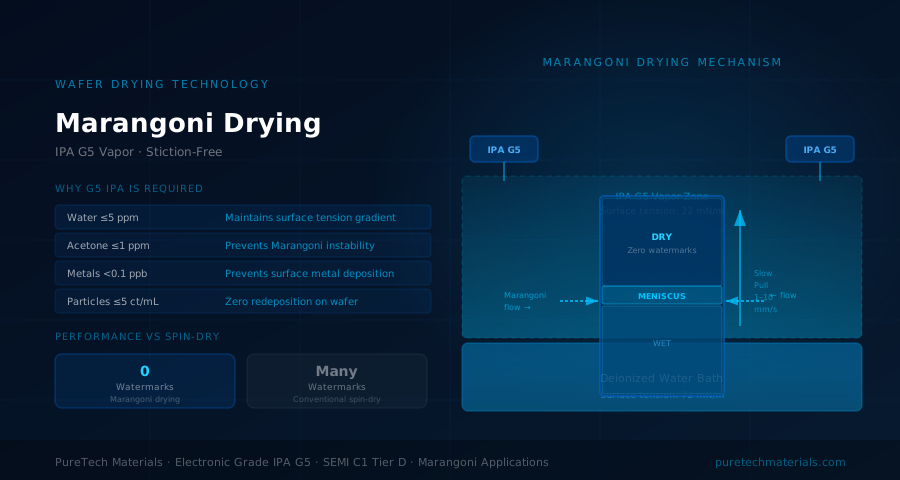
The Marangoni effect describes fluid motion driven by surface tension gradients. Water has a surface tension of ~72 mN/m at 25°C; IPA has a surface tension of ~22 mN/m. When IPA vapor is introduced above a wet wafer surface, IPA dissolves preferentially at the water surface, creating a localized region of reduced surface tension.
This surface tension gradient drives a flow from the low-tension IPA-rich region toward the high-tension pure water region — effectively pulling the water droplet horizontally across the wafer surface toward the edge, where it drains off. The wafer surface dries without the droplet evaporating in place, which is the mechanism behind watermark formation.
Marangoni Drying Process Implementation
Slow-Pull Marangoni Drying
In the most common implementation (used in AMAT, Lam, and Tokyo Electron post-CMP systems), the wafer is immersed in deionized water, then slowly withdrawn from the bath at 1–10 mm/s while IPA vapor is blown across the withdrawing water meniscus. As the wafer exits the water, the meniscus maintains Marangoni flow that sweeps the water surface dry ahead of the receding waterline. The dried wafer surface has particle counts typically <1/cm² for G5 IPA.
IPA Spray Marangoni Drying
In spray implementations, dilute IPA (5–15% in deionized water) is sprayed onto a slow-spinning wafer. The IPA creates the Marangoni gradient across the entire wafer simultaneously, enabling faster throughput than slow-pull. This method is used in some MEMS and power device fabs where throughput is prioritized over absolute particle performance.
Why G5 IPA Is Essential for Marangoni Drying
The efficiency of Marangoni drying is fundamentally limited by the IPA/water surface tension gradient. Any contaminant in the IPA that reduces its purity reduces this gradient:
Water Content Requirement
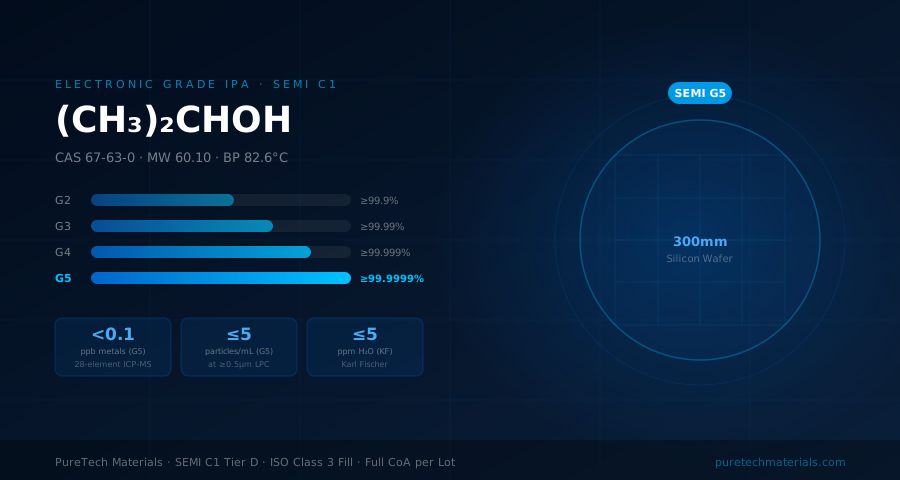
G5 IPA (≤5 ppm H₂O) is specified for Marangoni drying because excess water in the IPA reduces the surface tension gradient. At 50 ppm water (G2 grade), the gradient is sufficient for 28nm+ nodes but marginal for sub-7nm. At ≤5 ppm (G5), the gradient is maintained even at the low IPA vapor concentrations used in pull-type systems. Field data from leading fabs shows that switching from G4 to G5 IPA in Marangoni dryers reduces post-dry particle counts by 40–60%.
Organic Impurity Control
Organic impurities in IPA (acetone, propanal, 2-butanol) have surface tensions different from pure IPA, disrupting the Marangoni flow pattern. G5 IPA specifies acetone ≤1 ppm to prevent Marangoni instability — non-uniform drying that appears as arcuate watermark patterns.
Metal Ion Control
Metal ions in IPA are carried to the wafer surface by the Marangoni-driven water film. Even at 0.1 ppb, iron (Fe) and sodium (Na) can create metal contamination exceeding fab limits after deposition. G5 IPA (total metals <0.1 ppb each) ensures metal deposition below TXRF detection limits (<10⁹ atoms/cm²).
Marangoni Drying for MEMS and High-Aspect-Ratio Structures
Conventional spin-dry causes stiction — the collapse of released microstructures due to capillary forces during drying. For MEMS accelerometers, gyroscopes, and microfluidic devices with suspended structures, conventional drying has 100% stiction failure rates at aspect ratios above 5:1. Marangoni drying (or supercritical CO₂ drying) reduces capillary forces by minimizing the time that liquid bridges exist between surfaces. G5 IPA Marangoni drying achieves stiction-free yields for aspect ratios up to 20:1 for silicon microstructures.
Comparison: Marangoni vs. Supercritical CO₂ Drying
| Parameter | Marangoni (IPA) | Supercritical CO₂ |
|---|---|---|
| Capillary force elimination | Partial (surface tension minimized) | Complete (no liquid phase) |
| Aspect ratio capability | Up to ~20:1 | Up to 100:1+ |
| Throughput | High (60+ wph) | Low (10–20 wph) |
| Cost | Low | High (pressure vessel) |
| IPA consumption | 0.5–2 L/wafer | Not required |
| Particle performance | <5 particles/cm² (>0.2μm) | <1 particle/cm² |
Conclusion
Marangoni drying with G5 electronic grade IPA is the industry-standard method for watermark-free, stiction-free wafer drying at sub-7nm nodes and in MEMS fabrication. The G5 specification (≤5 ppm H₂O, <0.1 ppb total metals, ≤1 ppm acetone) is not over-specified — each parameter directly impacts Marangoni flow stability, particle redeposition, and metal contamination at the wafer surface.
Tags
Related Search Topics
PureTech Materials — Technical Team
Practical technical content for buyers, quality teams and process specialists comparing high-purity chemical specifications, qualification evidence and supply routes. Product claims remain subject to the current controlled specification and project review.