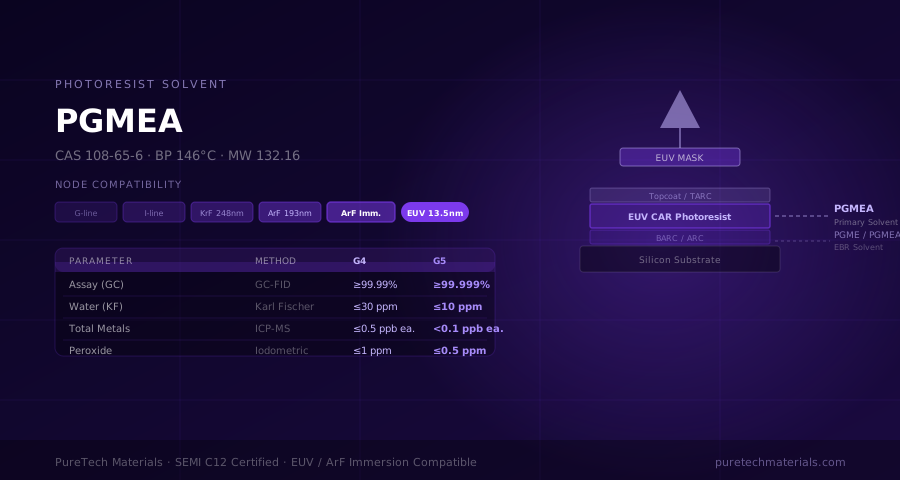
For a US photoresist formulation team, PGME and PGMEA can look like adjacent purchasing options: both are propylene-glycol methyl ether family solvents, both appear in lithography supply discussions, and both may be described with shortened names on a quotation. That similarity is exactly why the purchase specification must be precise. A PGMEA and PGME purchasing guide should start with identity, intended formulation role and controlled evidence—not with a generic request for a high-purity solvent.
SEMI C72 identifies PGME, PGMEA and a 70 wt% PGME/30 wt% PGMEA mixture as solvents used in semiconductor advanced-resist technology. It is a useful standards context, but it does not select a solvent, approve a resist formulation or create an acceptance limit for a specific buyer. The formulation owner must decide which solvent, blend, grade and impurity controls are appropriate for its own polymer, additive package, coating process and customer requirements.
Write chemical identity so a supplier cannot guess
Record the full chemical name, CAS Registry Number where used by your system, required isomer information, product grade, concentration or blend ratio, intended use, and the revision of the approved formula. OSHA identifies PGMEA as 1-methoxy-2-propyl acetate, CAS 108-65-6, and its sampling-method documentation distinguishes PGME and PGMEA names and isomers. This matters operationally: an abbreviation, trade name or family description should not be allowed to stand in for the material actually approved.
For a PGME PGMEA identity verification, connect the purchase request to a controlled specification and the formulation bill of materials. Ask the supplier to identify the product code, manufacturing or filling location where available, lot-number format, SDS revision and current CoA format. If a confidential resist formula is involved, define an appropriate protected route for technical questions instead of putting sensitive composition details in ordinary quotation correspondence.
Use the electronic-material product route as a starting point, then keep the buyer’s approved identity and evidence set with controlled documentation. This creates a record that procurement, formulation, EHS and quality can use consistently.
Define the formulation question before comparing certificates
A high assay alone cannot predict how a solvent will behave in a specific resist or coating blend. Define the actual process question: Is the material used as the principal formulation solvent, a diluent, an edge-bead-removal solvent, a rinse, or a component of a defined mixture? What polymer, solids content, additives, filter and storage conditions are involved? Which attributes could affect mixing, filtration, coating, bake response, defect review or downstream equipment cleanliness?
Turn those questions into a controlled, method-specific request. Depending on the formulation and process, a team may review identity and assay, water, acidity or alkalinity, non-volatile residue, colour, organic-impurity profile, trace-metal panel and liquid-particle data. Define the method, units, reporting limits and whether results are release tests, typical values or non-routine information. Do not borrow numerical limits from another fab, another resist or a promotional brochure. A supplier result below its own reporting limit is evidence only within the scope of that method and report.
SEMI C1 is referenced by C72 as a guide for analysis of liquid chemicals. That linkage supports a practical procurement rule: request analytical evidence together with the method context needed to interpret it. It does not allow a buyer to assume every parameter, detection limit or process condition is identical across suppliers.
Qualify a lot and delivery system, not an ideal bottle
A bench sample can establish an initial formulation screen, but routine supply arrives through a specific packaging, closure, storage and transfer route. During a photoresist solvent packaging qualification, document the intended commercial pack, contact materials, fill configuration, tamper evidence, storage conditions, sample method and point-of-use transfer equipment. Confirm that the qualified sample represents the proposed production route where that distinction could affect moisture, particles or contamination.
Evaluate representative lots in the actual mixing and coating workflow. Compare the candidate and qualified material under matched recipe, filtration, dispense, spin, bake and inspection conditions. Record the lot, preparation date, operator, container history, filters, equipment and method revision along with the result. This does not prove that solvent quality controls every coating outcome—tool settings, ambient conditions, resist age and wafer condition also matter—but it makes the solvent contribution reviewable.
Do not treat a passing first lot as a permanent waiver of incoming controls. Retain the supplier CoA, receipt inspection and internal qualification outcome against the lot. Link material release to batch traceability so later formulation or defect investigations can distinguish a supplier lot change from a process change.
Keep EHS and product qualification in the same release file
Technical suitability and safe handling are connected but different decisions. OSHA lists PGMEA as a flammable liquid and provides chemical-identity and occupational-exposure information; site EHS personnel must determine the applicable controls for the actual use, ventilation, storage, personal protective equipment, waste and emergency arrangements. A supplier SDS is a controlled hazard-communication document, not proof that a material is suitable for a particular formulation or that every site control has been met.
Before routine release, obtain the current SDS for the delivered product and destination, confirm that the product code and identity match the procurement record, and route it through the site’s EHS document process. If the product is imported, shipped interstate or repacked, identify who owns the applicable transport and hazard-communication decisions. Do not turn a general OSHA data page into a legal conclusion for a particular facility.
This distinction is useful for US photoresist formulation solvent supplier reviews: formulation evaluates technical and quality evidence; EHS evaluates safe-use controls; procurement ensures the approved product and pack are ordered; and quality controls the records and changes. The same material should not be released merely because one team has completed only its portion of the assessment.
Make changes visible before they reach a mixer
Set written notification triggers with the supplier. Relevant examples include chemical identity or isomer distribution, blend ratio, manufacturing or filling location, production route, purification stage, specification, analytical method, reporting limit, packaging, closure, storage instruction, product code, lot format and SDS revision. The buyer should agree which changes require advance notice, which records will accompany the notice, and who may approve use after review.
When a supplier proposes a change, first establish exactly what changed and which existing evidence it affects. A new fill site or closure is not automatically unsuitable, but it is not automatically equivalent either. Compare the new configuration to the approved specification and risk assessment, decide whether document review, incoming testing, a formulation trial or a broader requalification is warranted, and record the conclusion before material enters production.
A lithography solvent change control process protects both supply continuity and technical control. It avoids two common failures: rejecting a controlled, adequately evaluated change because the team has no decision path, and accepting a commercially convenient substitution because the abbreviation on the drum looks familiar.
PGME and PGMEA buyer checklist
- State the full identity, CAS information where used, isomer expectation, grade, blend ratio and approved formula revision.
- Define the formulation role and critical attributes rather than asking only for a purity percentage.
- Request CoA, method, units, reporting-limit and lot-format information tied to the exact product.
- Qualify representative lots in the intended mixing, filtration and coating workflow.
- Qualify the production pack, closure, storage and transfer route—not only a laboratory sample.
- Control SDS and EHS review separately from formulation suitability.
- Retain lot, receipt and internal results through traceability controls.
- Review identity, site, method, specification and package changes before use.
A well-defined PGMEA CoA supplier review gives a formulation team an evidence trail without claiming that one solvent is universally correct. For a proposed solvent, pack and application, explore analytical-testing support, application routes and request a technical review.
Primary sources
Tags
Related Search Topics
PureTech Materials — Technical Team
Practical technical content for buyers, quality teams and process specialists comparing high-purity chemical specifications, qualification evidence and supply routes. Product claims remain subject to the current controlled specification and project review.